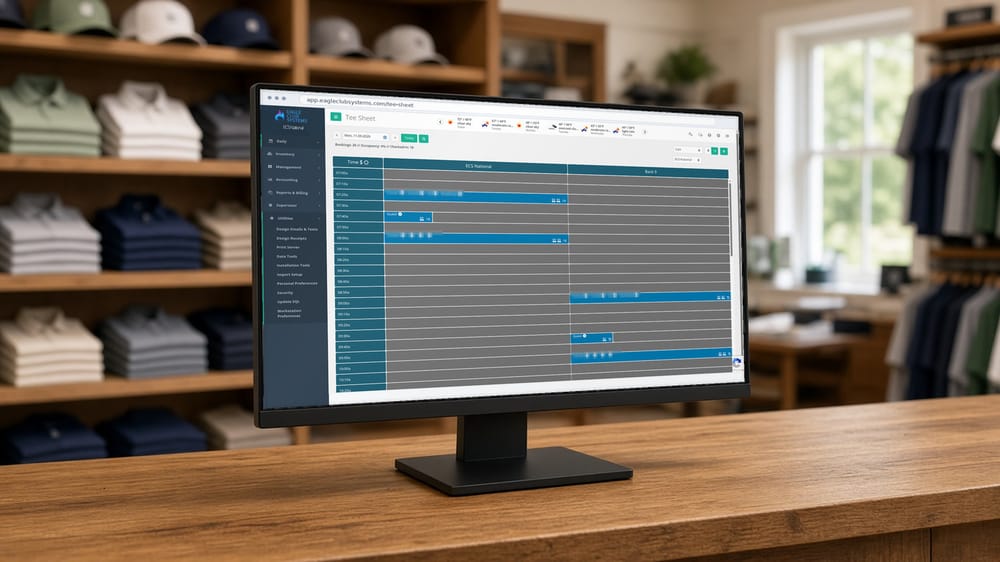
If you have ever had to reconcile a tee sheet in one system, restaurant sales in another, and member billing in a third, you already know the real problem with a lot of golf course management software companies. It is not that they lack features. It is that the features do not always share a customer record, and the gaps show up when your staff is busiest.
I have spent more than 24 years in golf operations. The useful comparison is not a logo lineup. It is whether the platform can check in a prepaid player, move a group after a frost delay, post a member charge from the restaurant, and close the day without a spreadsheet. This article is a starting point, not a verdict. For deeper, sourced side-by-sides, use our comparison hub and the vs-pages linked below, and confirm current packaging in a live demo.
Here is a common reason a course starts shopping. Month-end billing takes the back-office person far longer than it should, because restaurant charges, dues, and tee-sheet records do not land on the same statement. Or picture a Saturday morning when a prepaid flag did not show up on the tee sheet, support is a ticket queue, and the first tee is waiting. The software still has the usual features. The handoffs are what broke.
The criteria that actually separate golf course management software companies
Most providers can check tee sheet, POS, and reporting on paper. Ask these questions instead.
Do the tee sheet, online booking, and register share a live database? If staff wait on a sync, prepaid flags, rates, and customer profiles will drift. Watch a group move, a no-show, and a phone booking appear on the starter’s screen.
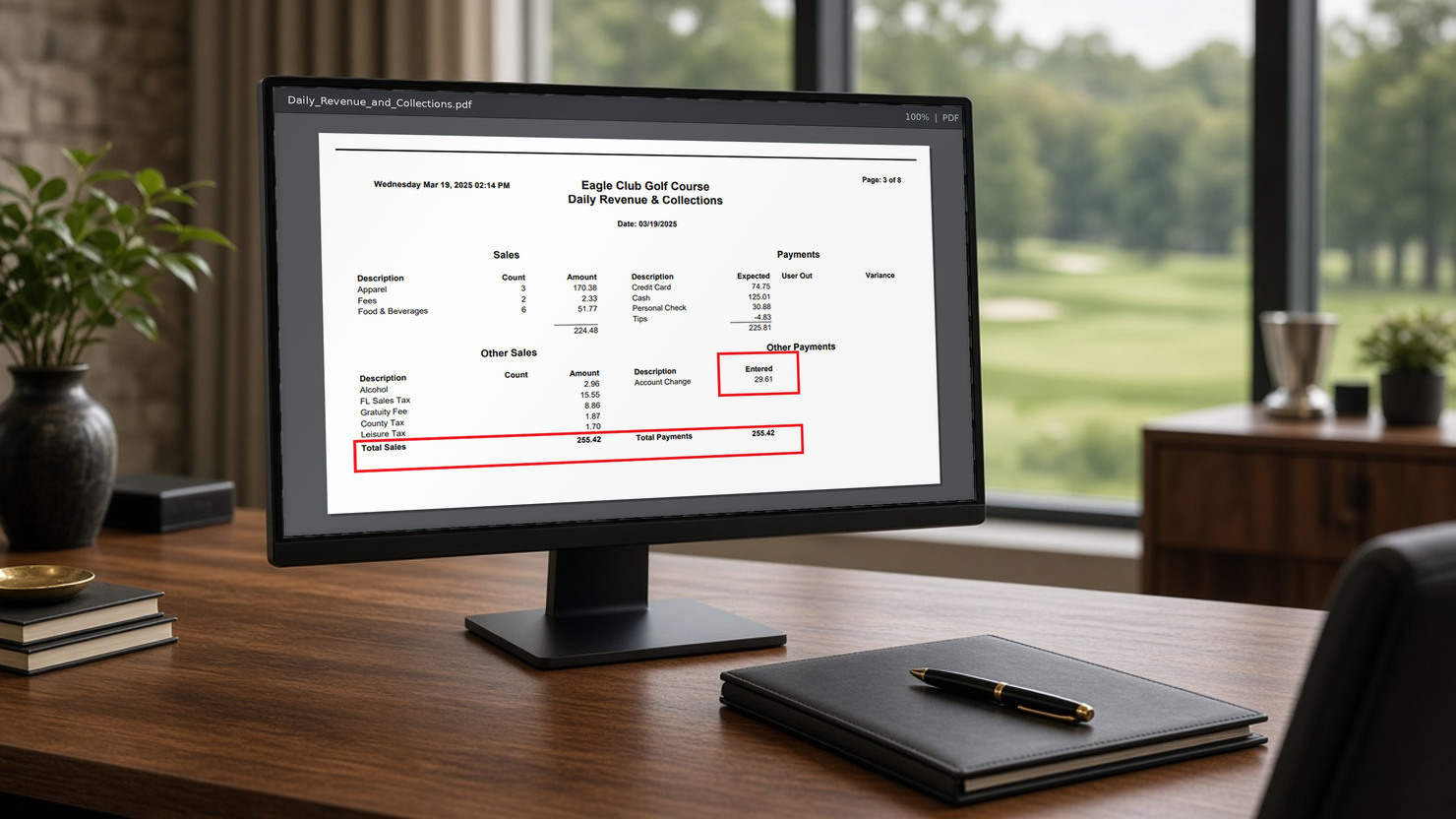
Can the POS finish a real golf ticket? Split tenders, rain checks, member charges, house accounts, and food-and-beverage tabs are not edge cases. If the restaurant lives in a separate product, ask to see one member statement and the end-of-day close.
How does membership billing actually run? Recurring dues, family accounts, failed payments, and credits should be demonstrated on your calendar. If billing or marketing is an add-on, get that in writing.
Who decides your payment processor? Some companies promote a built-in processor, or charge extra to use another one. Eagle Club Systems offers integrated CardPointe and also lets a course use another processor on a non-integrated basis. Compare effective rates, hardware, and contract terms, not just the software fee.
What happens when the internet drops, and what is actually included? Many modern platforms, including Eagle Club Systems, are cloud-based and cannot run fully offline; a tested hotspot or LTE backup is the honest plan. Websites, apps, events, accounting, and marketing services are often packaged differently. On Eagle Club Systems, implementation and data conversion are included at no charge, there are no long-term contracts, and most courses go live in under two weeks after data is provided. Tournaments and leagues run through Golf Outing Guru and Golf League Guru alongside the tee sheet. There is no native online merchandise store. Managed marketing is a paid add-on. We do not publish a self-serve price table, and support is U.S.-based, seven days a week, typically 6 a.m. to 10 p.m. — not 24/7.
Those limits belong in a comparison just as clearly as the strengths. The companies below have strengths of their own.
A fair look at the companies operators usually shortlist
Club Caddie is a browser-based platform founded by golf course owners in 2014 and owned, since 2020, by Jonas Software, a division of Constellation Software Inc. It markets a modular monthly system covering tee sheet, POS, food and beverage, member billing, banquets and events, accounting, marketing, custom websites, and a branded mobile app, with 24/7 support and optional distribution to third-party tee time marketplaces. It may fit better if you want native events, built-in general-ledger accounting, or marketplace distribution. Eagle Club Systems may fit better if you want payment-processor choice, no long-term contracts, and operator-led support, and you are comfortable running tournaments and leagues through partner tools.
Club Prophet has provided golf course software for more than 30 years, according to its website, and describes a dual-platform strategy. Club Prophet Signature is the legacy, on-premise system Club Prophet says is installed in more than 1,400 courses worldwide. Club Prophet Cloud is a separate cloud platform it says is already in use at hundreds of courses, with native waitlists, built-in tournament management, and a branded mobile app. Online reservations, marketing, member billing, food and beverage, and mobile solutions are listed on Club Prophet’s features page as add-on modules. It may fit better if you need an on-premise environment, or you already run Club Prophet and are satisfied with it. Eagle Club Systems is a single cloud platform and cannot operate entirely offline.
Jonas Club Software is a broader, modular private-club suite — and a different product from Club Caddie, even though both sit in the Jonas Software family. Official pages describe ClubHouse Online websites and a mobile app, mobile POS (including Stripe, and order-taking when Wi-Fi or data is lost), dining reservations, tee time management, club accounting, and event management. The Sheet™ is Jonas’s web-based tee sheet, designed to live inside Jonas. Jonas Software’s club-management page has stated that the product is used by over 2,200 clubs in more than 17 countries; treat that as a corporate-site figure and confirm it in a buying conversation. A full-service private club that wants an in-platform general ledger may start here; a daily-fee or municipal course should compare that scope carefully.
foreUP is a widely adopted cloud platform known publicly for an easy-to-use tee sheet and POS. foreUP has stated that it is used by more than 2,000 courses and runs through a Chrome-compatible device on an internet connection, and it publishes a list of approved printer models. Public reviews are often positive on onboarding, usability, and support; some reviewers have asked for stronger report consolidation or more granular permissions. It may fit better if your staff already knows the product or you want a standardized ecosystem at that scale. Eagle Club Systems is not restricted to Chrome and supports USB, Bluetooth, or Ethernet receipt printers depending on the workstation.
Teesnap markets a connected, mobile platform for tee sheet, POS, online booking, payments, marketing, food and beverage, and reporting. Teesnap specifies that transaction devices and card readers are provided by Teesnap. Teesnap Payments promotes flat-rate processing, surcharge, cash discounting, ACH, and major wallet and card methods. Teesnap states that implementation typically takes two to four weeks and includes unlimited training and ongoing support, and it describes Auto Pay running on the 15th and dues on the 1st. It may fit better if you prefer a mobile-first ecosystem and vendor-provided payment hardware. Eagle Club Systems emphasizes flexible hardware and browser access, and membership Auto Pay can be set for any day of the month.
Lightspeed Golf is a cloud tee-sheet and booking product that reviewers often praise for usability, reporting, and support. Lightspeed Golf, Retail, and Restaurant remain separate applications with their own setup, reports, and reconciliation. House Accounts 2.0 is intended to consolidate charges; older documentation and verified reviews have described syncing delays or confusing statements, so confirm the exact version in your proposal. Official onboarding documentation says Lightspeed Golf operates entirely through Google Chrome. Lightspeed promotes Lightspeed Payments, and some Golf card-on-file workflows require it; confirm processor rules and any third-party fees in writing. It may fit better if you are already invested in that commerce ecosystem. Eagle Club Systems keeps golf retail, food and beverage, memberships, and reporting in one golf-operations platform.
GolfNow is usually a different buying decision: a consumer marketplace, not a peer to a full operations platform. Some management systems, including Club Caddie, offer optional marketplace distribution. If you are weighing direct booking against third-party inventory, read Eagle Club Systems vs GolfNow and what barter actually costs, and require a clear picture of which times you are handing over.
What different facilities should prioritize
Public and daily-fee courses usually need speed at the counter, a booking path golfers will finish, and rate control that does not depend on a marketplace. Private clubs tend to put more weight on member accounts, dining charges, and a billing calendar the controller trusts. If you need a full club general ledger or native banquet contracts, put Jonas Club Software or Club Caddie on the shortlist and make them prove those workflows. Municipal facilities often need a go-live a lean team can survive. Indoor simulator venues should add bay scheduling and a POS that can close a bar tab on the same visit.
Require the same Saturday script from every company: book and move a group, check in a mixed-payment foursome, post a member or house charge, run an F&B tab, close the day, and produce the reports your owner or board already uses. Then ask who converts your data, how long go-live takes after that data is provided, who trains your staff, and who picks up the phone on a Saturday.
If you want to run that script on Eagle Club Systems, book a demo and bring your rate sheet, a payment statement, and a real Saturday ticket. Use the comparison hub to go deeper on any one vendor. The right company is the one that makes that Saturday simpler — not the one with the longest feature list.
FAQ
Which golf course management software companies should we compare?
Start with the platforms that already serve facilities like yours, then compare them on live workflows rather than logos. Operators often shortlist Club Caddie, Club Prophet, Jonas Club Software, foreUP, Teesnap, Lightspeed Golf, and Eagle Club Systems. Use our comparison hub and the individual vs-pages for sourced detail, and confirm every claim in a current demo.
Is Club Caddie the same thing as Jonas Club Software?
No. Club Caddie has been owned by Jonas Software since 2020, but it is a different product from Jonas Club Software. Club Caddie is a golf course management platform; Jonas Club Software is a broader modular suite marketed heavily to private clubs. Compare them separately.
How should we compare golf course management software companies in a demo?
Make each vendor run your check-in, a tee-time move, a split tender or member charge, a food-and-beverage tab, and your end-of-day close. Then ask about payment processing, hardware, internet failover, data conversion, support hours, and what is included versus sold as an add-on.
Does Eagle Club Systems include implementation at no charge?
Implementation and data conversion are included at no charge. Most courses go live in under two weeks after data is provided, and Eagle Club Systems states there are no long-term contracts. Get a written conversion and training plan before you sign. Pricing is quote-based, not a self-serve table.
Can these platforms run if the internet goes down?
It depends on the vendor and the product. Eagle Club Systems is cloud-based and cannot run fully offline; a hotspot or LTE backup is the honest failover plan. Jonas publicly describes mobile POS order-taking when Wi-Fi or data is lost, and Club Prophet Signature is positioned as on-premise. Ask each company to show the exact outage behavior included in your proposal.